Restraining orders stir up mayoral race

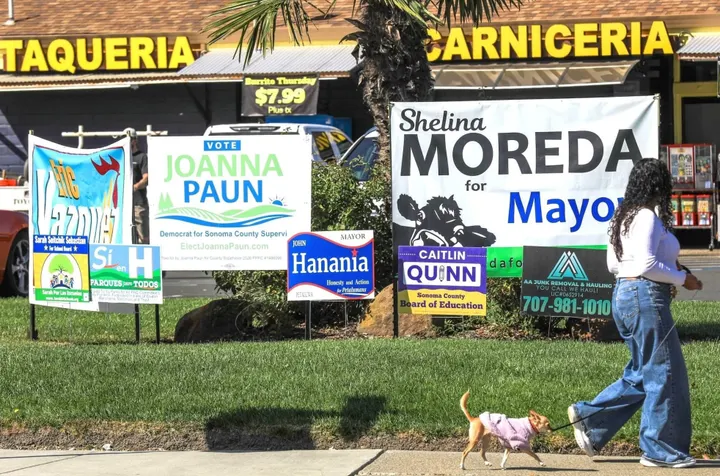
The race for mayor of Petaluma has been among the strangest and most heated elections in recent city memory, with spats between candidates, unexpected revelations, and reporters being kicked out of campaign events.
To top it off, two of three candidates in the race have been subject to restraining orders in recent years – although under very different circumstances. The supporters of one of those candidates, Shelina Moreda, are crying foul. They claim the press has treated Moreda unfairly because the coverage of her restraining order made headlines while the restraining order against the other candidate, John Hanania, was addressed less prominently in news coverage.
An investigation by Petaluma Voice into the two orders reveals that there are key distinctions between them, and the one sought against Hanania did not stand up to scrutiny in court.
Moreda’s restraining order dismissed after settlement
The Moreda temporary restraining order was a “domestic violence” restraining order, alleging that Moreda stalked and threatened her ex-boyfriend, broke a window, and repeatedly sent him strings of texts in late 2025. Her ex-boyfriend testified under oath that he feared she would try to physically harm him – and was threatening his reputation at work and online – that led him to seek a restraining order.
That restraining order was backed by significant evidence, including a surveillance camera snapshot of Moreda allegedly breaking the window of a Tahoe home where the ex-boyfriend had gone to escape her, and a $500 check she left to pay for the damage. Other evidence included strings of text messages, flipping from angry to conciliatory, and joking about driving after drinking when he expressed concern, later saying she stopped drinking two hours earlier.
Moreda has issued a public statement, but has refused to talk about the temporary restraining order with the press and has kicked Petaluma Voice out of campaign events that were listed as open to the public. The restraining order, which was requested for a period of five years, was dismissed in December 2025 during a second court hearing when attorneys for the two parties announced they had made an agreement to settle the matter. The terms of the agreement remain under wraps.
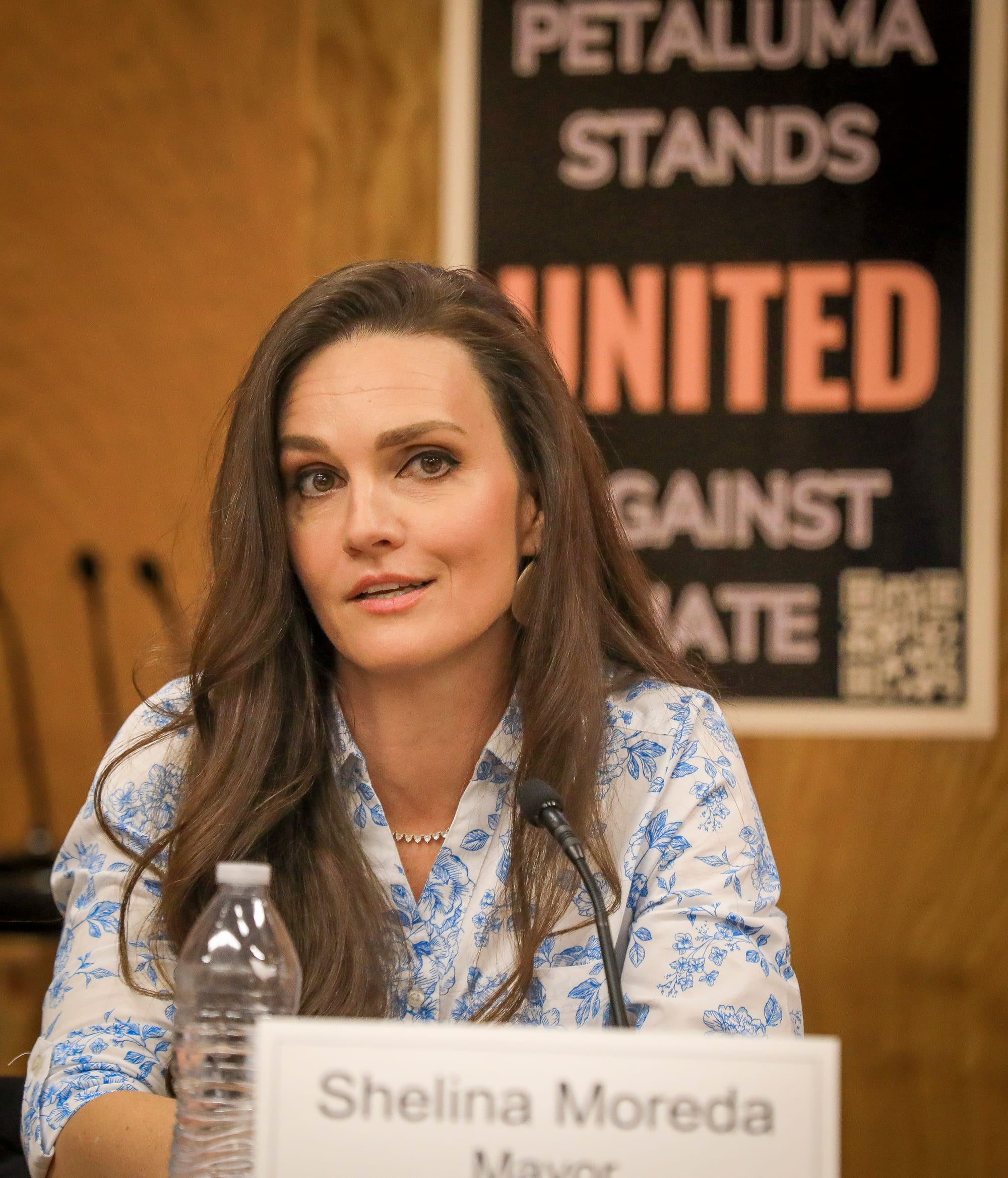
Moreda, in her Sept. 1 statement on the matter, said “no order was ever issued against me on the merits.” She questioned the value of reporting the facts of the case, wondering why that would be useful to voters since it “never resulted in a finding.” Petaluma Voice reached out to Moreda for comment for this story, and received no reply.
When Petaluma Voice broke the story on the Moreda temporary restraining order, political analyst Brian Sobel, a former Petaluma council member, was asked about why a temporary restraining order or any other skeletons in the closet – for any of the candidates – might be relevant to voters.
“If you’re going to be in public office, you’re going to oversee a law enforcement agency, in this case a police department in a city,” he said in September. “If you're the mayor, you're the top person in the community. You need to explain what happened to the best of your ability if you want to run for office.”
Hanania’s restraining order thrown out
In contrast to the restraining order against Moreda, a 2024 temporary restraining order against candidate John Hanania was a “civil harassment” order.
The biggest difference between the two cases is that the Hanania order was quickly tossed out by a judge, failing to survive its first evidentiary hearing. Hanania refused to settle the case with an agreement, because he alleged – and the court agreed – that the case didn’t stand up to evidentiary scrutiny.
In fact, the petitioner in the Hanania case had several conflicts in her testimony, according to court records and the people involved in the case. The conflicting stories played a significant role in convincing the judge to dismiss the order. Petaluma Voice is currently withholding her name, because unlike the candidates running for office, she is not a public figure.
However, according to court records and the people involved, Petaluma Voice has learned she has a history of similar allegations and other legal actions. Attempts to reach the petitioner by Petaluma Voice were unsuccessful.
Adding to the woman’s problems in convincing the judge, she provided no photographic or video record to the court to back up her claims, and she never called authorities to report any of the alleged misdeeds, according to Hanania.
Hanania claimed in an interview on Thursday that the woman requesting the order had ulterior motives. To explain this, Hanania said he had tried to help the woman by offering transportation several times and trying to find her a place to live, because she is, like Hanania, of Middle Eastern descent, and she was struggling as a widowed mom with a young daughter.

“I treated this person as my baby sister,” Hanania said, adding that none of her disturbing allegations were true. “I can swear on a Bible if you like. I can take a lie detector test if you like.”
The woman in 2023 called Hanania to ask him to give her and her daughter a ride to a west Petaluma property, where another man, Peter Tscherneff, was living, Hanania said. Tscherneff, who was in a relationship with the woman, questioned Hanania’s motives when he took her to the property and allegedly grabbed a baseball bat and threatened to break Hanania’s legs. Hanania called 911 and ultimately won a five-year restraining order protecting him from Tscherneff.
Tscherneff has been described in news accounts as a bright and difficult man, with a history of protest, disruption, and arrest, including more than a dozen Sonoma County cases on record.
The woman, meanwhile, lived in a house on a property where Hanania rented two old chicken barns and a storage shed for his mechanic business and personal belongings. Because of the existing restraining order, Tscherneff is barred from going to the property because Hanania makes regular trips to his storage sheds, passing by the woman’s house.
According to court records, when Tscherneff resumed his relationship with the woman in 2024, he attempted to have his own restraining order removed so he could visit her at the home where she lived. When that request was rejected by a judge, the woman attempted to obtain a restraining order against Hanania.
If the restraining order was successful, Hanania would have had to remove his belongings from the property, and Tscherneff would have been able to resume going to the woman’s home. Hanania insists that was the motive for the attempted restraining order.
One of the witnesses who testified in the case, the woman’s former landlord, Robert Russell, 76, backed up Hanania’s version of events.
“I can defend John on all counts,” Russell said, when reached by Petaluma Voice.
Since then, Russell has had to defend himself against similar allegations brought by the woman after he evicted her, he said. He said Hanania never harassed her, and described the woman as being “off the wall.”
“He tried so hard to help the lady and she just bit him. She has a history of this crap,” Russell said. “The judge threw it out, all of it … it was all made up.”
Spats between candidates
Hanania and Moreda have had contentious exchanges during the election campaign. Moreda initially told him if he was running, she wouldn’t enter the race and would back him instead, according to Hanania. He confirmed he was running weeks before the deadline, then she decided to put her hat in the ring anyway.
Later, Moreda pressured Hanania to bow out and let her take on incumbent Mayor Kevin McDonnell herself, Hanania said. He refused, and since then she has accused him of stealing her campaign signs and spreading falsehoods about her, Hanania said.
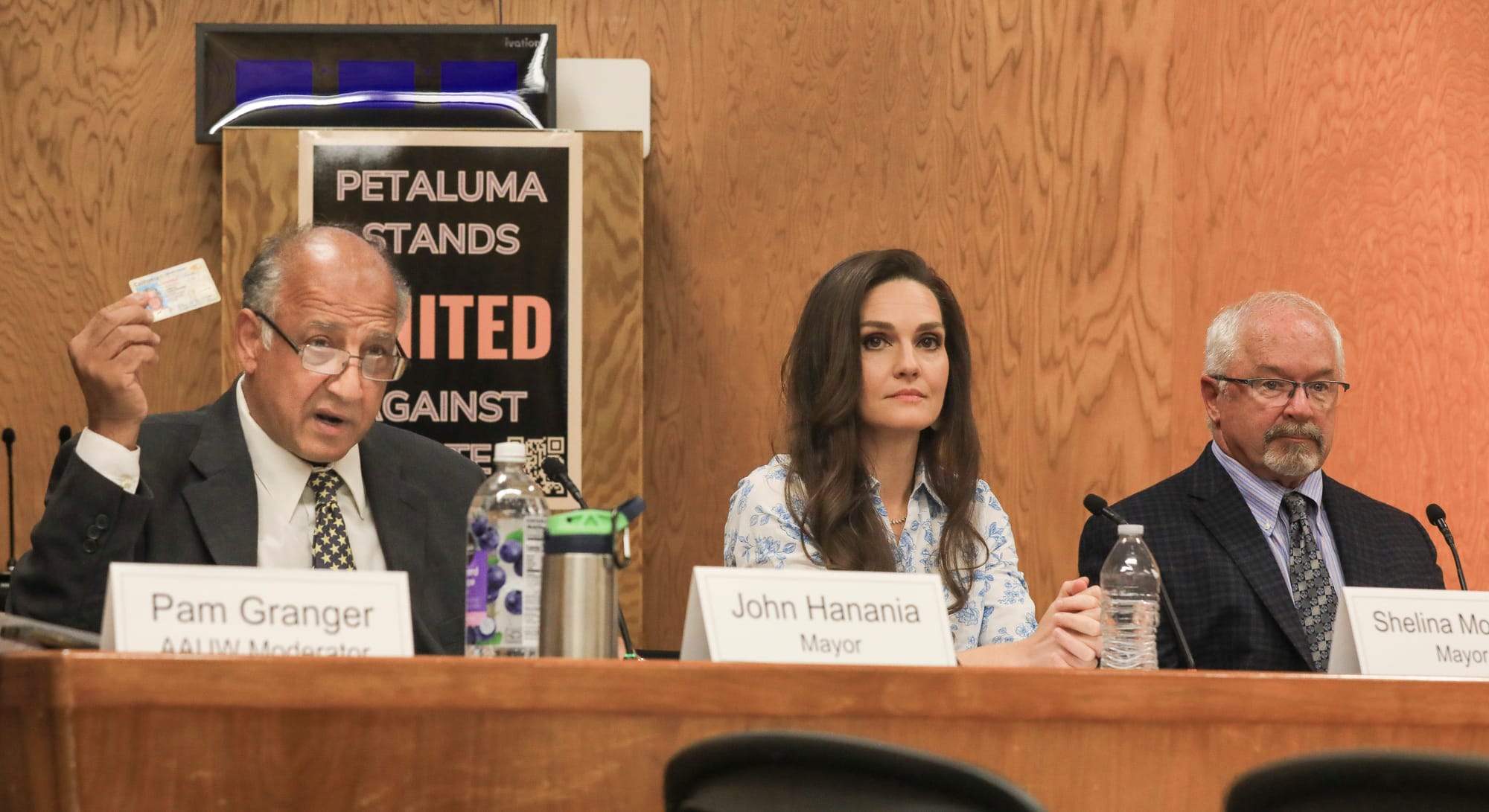
In a moment that reflected the bitterness between the two, and drew a contrast between his own idea of transparency and Moreda’s, Hanania held up his California drivers license during an Oct. 12 forum as proof of his age.
It was a subtle dig at Moreda, who when she ran for Sonoma County supervisor months earlier told a Press Democrat reporter she was 38, which appeared in print and online, instead of her actual age of 44. When she was asked to explain the discrepancy, she claimed she offered a different age to protect herself from stalkers because of her experience as a woman in the male-dominated sport of professional motorcycle racing.
She came in third in the June supervisorial primary, failing to make the Nov. 3 runoff between Joanna Paun and Sylvia Lemus.
As far as legal issues go, McDonnell took to social media recently to address his own faux paus. His trouble was not in recent years – it was a bankruptcy 21 years ago. He heard it being raised as a campaign issue, and wanted to get out in front of it, he said. In an interview earlier this month, he said he was upset that an issue from so long ago would be raised in a local campaign, saying that Petaluma’s election is reaching new lows.
Hanania agreed.
“It’s really getting heated,” Hanania said in an Oct. 13 interview with Petaluma Voice. “This is the worst I have seen since 1990,” Hanania said, referring to around the time when he moved to Petaluma. “People are throwing mud like there’s no tomorrow.”
For the record, McDonnell was asked and said he has never been subject to a temporary restraining order, or any other legal trouble aside from the bankruptcy. A search of Sonoma County court records supports his statement.
Reporter Jennifer Sawhney contributed to this report.
Tobias Young is an editor and reporter at Petaluma Voice. He can be reached at tyoung@petalumavoice.org.
Do you like our work? Support us with a tip.